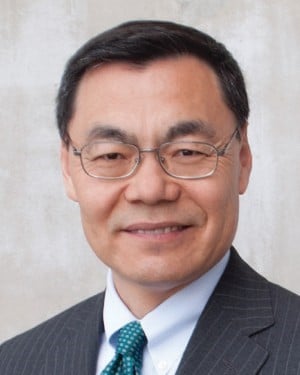
When Dr. Zijun Hao arrived in Lincoln, Nebraska, in the summer of 1989, he knew very little about the state that would eventually become home.
He had grown up more than 6,000 miles away in Jinan, China, a city of more than five million people. The oldest of four children, Dr. Hao was raised in a family that placed a high value on education. His father was a chemical engineer, and his mother was a high school math teacher. His siblings would also pursue accomplished careers—one brother became a civil engineer in China, another a petrochemical engineer now living in the Los Angeles area, while his younger sister remained in China.
When it came time for Dr. Hao to choose his own path, medicine intrigued him. His parents also thought it suited him.
There was another factor, he recalled with a smile: his parents expected at least one of their four children to become a doctor.
Zijun was the one.
Dr. Hao graduated from high school at just 16 years old and performed exceptionally well on China’s highly competitive National Higher Education Entrance Examination. At a time when the country had a significant need for physicians, his scores opened the door for him to begin medical school immediately.
He enrolled at Shandong University College of Medicine in Jinan, where medical school was an intensive five-year, year-round program—with no summers off.
Following graduation, Dr. Hao earned a spot in an orthopedic surgery residency program in Beijing. He spent approximately three and a half years there before an opportunity arose that would change the direction of his life.
While in Beijing, Dr. Hao met Dr. Garvin, a visiting professor who introduced him to an international exchange opportunity in Nebraska. Through a UNMC-sponsored program in Lincoln, Dr. Hao was selected to come to the United States as a hand surgery fellow.
His parents were thrilled.
Dr. Hao, meanwhile, knew virtually nothing about Nebraska.
In the summer of 1989, he packed his bags and came to Lincoln.
Coming to Nebraska in 1989 was more than a professional opportunity for him—it was the beginning of an entirely new life.
After spending a year in Lincoln training as a hand surgery fellow, he moved to Omaha and enrolled in a graduate Ph.D. program at the University of Nebraska Medical Center. His work focused on basic science and research, including studying arthritis in the knees of monkeys. It was valuable work, but after about two and a half years, Dr. Hao found himself drawn back toward the reason he had entered medicine in the first place: he wanted to care for patients.
He began considering something that would require essentially starting over professionally—taking the U.S. medical board examinations and pursuing the opportunity to practice medicine in America.
He wouldn’t make that journey alone.
Dr. Hao had met his wife, Dr. Ruilin Wang, while the two were attending medical school in China. They married in 1987 while completing their medical training, and when Hao left for Nebraska two years later, Dr. Wang followed just three months after him, ready to begin their new life together in the United States.
Those first years were anything but easy.
In Lincoln, Dr. Wang worked nights as a nurse aide at Holmes Lake Manor. Later, after the couple moved to Omaha and welcomed their first son, she took a night position as a nurse aide at UNMC. Their schedules became a carefully coordinated effort to keep their young family moving forward: Dr. Wang worked at night so she could be home with their son during the day, while Dr. Hao attended school and continued his research.
And somewhere in the middle of work, school, night shifts and caring for a baby, the two found time to study.
Together, they prepared for the U.S. medical board examinations, both working toward the same goal of returning to the profession they had trained for in China.
After about two years, Dr. Hao accepted a research position at Southern Illinois University in Springfield, Illinois, and the young family moved once again. It was there that years of hard work began to pay off: both Hao and Wang passed their medical board examinations.
Their next opportunity brought them right back to Nebraska.
Both were accepted into residency programs at Creighton University in Omaha—Dr. Wang in family medicine and Dr. Hao in general surgery. Dr. Wang completed her three-year residency first and began working in Omaha while Dr. Hao continued through his six-year surgical training.
By then, Nebraska was no longer simply the place Dr. Hao had traveled to for a fellowship. It had become the place where he and his wife were building their careers, raising their family and creating a future together.
When Dr. Hao finally completed his general surgery residency, he didn’t waste much time deciding where that future would be.
Six days after finishing residency, he moved to Lincoln to begin his career with Lincoln Surgical Group.
His first weekend on call happened to fall on the Fourth of July.
More than 25 years later, he is still there.
Dr. Hao joined Lincoln Surgical Group in 2001 as a junior partner. More than two decades later, he is now a senior partner and has built a career rooted in the community he and his family came to love.
For Dr. Hao, general surgery proved to be an excellent fit. Although he trained in orthopedic surgery in China, his surgical skill translated naturally to a new specialty in the United States. Throughout his career, colleagues have frequently complimented his steady hands—an attribute he believes has served him well in the operating room.
He also appreciates the breadth and variety of general surgery and the opportunity to continually encounter different patients, conditions and challenges.
Today, Dr. Hao also serves as Director of the Burn and Wound Care Center at CHI Health St. Elizabeth, where teaching has become another important part of his career. He especially enjoys working with residents and sharing the knowledge and skills he has gained over decades of practicing medicine.
That role has taken on an especially meaningful dimension: Dr. Hao’s younger son is now a surgical resident in Lincoln and has the opportunity to train under his father.
Dr. Hao and Dr. Wang have two sons. Their oldest graduated from Princeton University and works in venture capital on Wall Street while living in Philadelphia. He and his wife have three daughters. Their younger son remained closer to home, pursuing medicine and surgery in Lincoln.
For a family whose journey began in China nearly four decades ago, medicine has truly become a family tradition.
After more than 25 years with Lincoln Surgical Group, Dr. Hao remains passionate about independent medicine and the autonomy it provides physicians.
For him, independence means having the ability to make decisions based on what he believes is best for the individual patient—not because of outside pressures or organizational demands.
That autonomy also strengthens something Hao considers essential to good medicine: the relationship between physician and patient.
Independent practice allows him to know his patients, listen to them and make decisions alongside them. It is a model of medicine that Dr. Hao has valued throughout his career and one he hopes continues for future generations of physicians.
Perhaps one of the most striking parts of Dr. Hao’s story is just how deeply a place he once knew nothing about has become home.
When he talks about Lincoln, his affection for the community is unmistakable. He and Dr. Wang have loved raising their family here. He speaks highly of Lincoln’s schools, its people and the friendliness they have experienced throughout their years in the community.
Nebraska gave Dr. Hao an opportunity when he arrived as a young surgeon from China in 1989. In the decades since, he has returned that investment many times over—caring for patients, mentoring residents, leading in burn and wound care and helping train the next generation of surgeons.
What began as an international fellowship became a career, a family legacy and a home.
OneHealth Nebraska is honored to have Dr. Zijun Hao as a member and grateful for his longstanding commitment to independent medicine and the patients and community he serves.
Drs. Hao and Wang are a remarkable couple. They are an enduring gift to the Lincoln community.