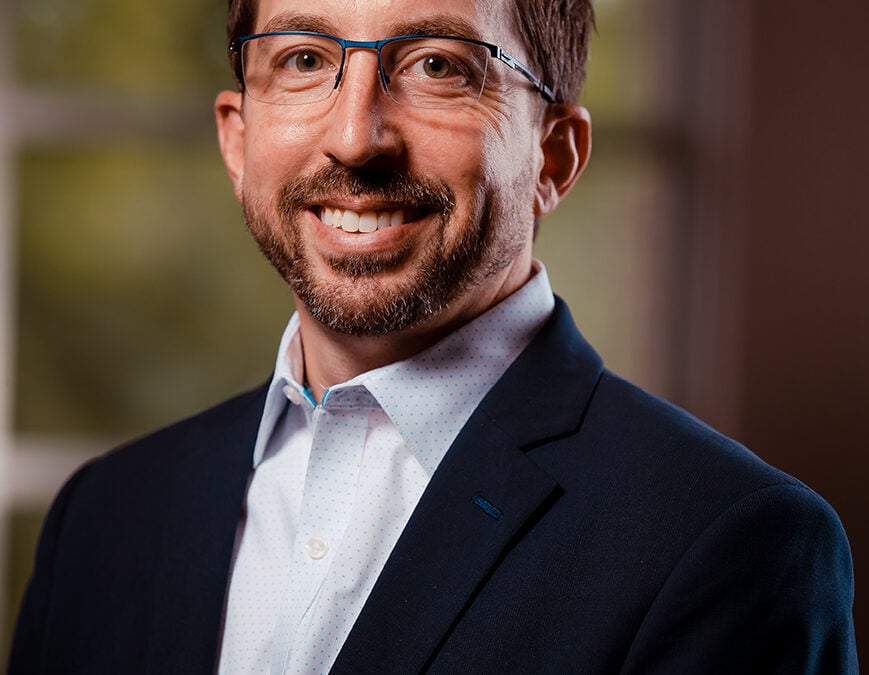
For Dr. Eric Avery, the path to medicine started long before medical school, residency or fellowship. In fact, it began around the family dinner table in Grand Island, Nebraska.
His mother was an OB/pediatrics nurse, and while other children might not have been interested in hearing stories from her workday, Dr. Avery was fascinated.
“I’ve known since I was like 8 years old that I wanted to be a physician,” he said. “I was the only one that wanted to hear my mom’s stories at the supper table.”
That early curiosity eventually led him to Doane College in Crete, where he majored in biology. Dr. Avery describes Doane as an important stepping stone—a place that helped a somewhat quiet and reserved young man come out of his shell. He played soccer, participated in student activities and volunteer programs, and took advantage of the college’s new science facilities.
After Doane, Dr. Avery completed medical school, residency and fellowship at the University of Nebraska Medical Center in Omaha—four years of medical school followed by three years each of residency and fellowship.
An Unexpected Path to Oncology
Interestingly, oncology wasn’t always the plan.
Early in his medical training, Dr. Avery thought nephrology might be his future. He loved its physiology and scientific complexity. Oncology, on the other hand, initially intimidated him. Like many people, he associated the specialty with some of medicine’s most difficult moments.
But an oncology rotation during the first few months of residency began to change his perspective. It was one of his most difficult rotations—physically demanding and emotionally draining. Yet something about it stayed with him.
Dr. Avery came to realize that physicians in every specialty encounter illness, loss and difficult outcomes. What stood out to him in oncology was something else entirely: the patients. He was struck by how engaged and dedicated they were to their care and by the relationships physicians could develop with them throughout their treatment.
“The challenge I liked, and it was really because of the patients,” Avery said.
While oncology presents its share of challenges, Dr. Avery quickly discovered the profound rewards of walking alongside patients during some of life’s most difficult moments.
“I just absolutely loved the patients,” he said.
Soon, the specialty he had once found intimidating became the one he couldn’t stop thinking about.
“I found what I really enjoy, and it’s kind of been that road ever since.”
That road eventually brought Dr. Avery and his family to Lincoln. His wife had put some of her own education on hold during his medical training and wanted to return to school to become a physician assistant. Her acceptance into Union College helped make Lincoln the right fit for their family. At the same time, Dr. Avery connected with Dr. Mark Hutchins at Nebraska Hematology Oncology.
Nearly 15 years later, he is still there.
Lincoln also became more than the place where Dr. Avery built his medical career—it became home. He and his wife have raised two daughters here, both of whom share a particular love for animals.
The People—Not the Building
Dr. Avery’s commitment to independent medicine is rooted in a straightforward belief: healthcare decisions should be driven by the people actually caring for the patient.
“The physicians, providers, and nurses taking care of patients are the ones who should really be making the decisions,” he said.
It’s a philosophy he explains with an equally simple idea: patients aren’t cared for by the name on the outside of a building. They are cared for by the people inside it.
“If I had to refer a family member somewhere, I’m going to refer them to a physician,” Dr. Avery said. “I’m not going to refer them to a building. I’m going to refer them to the person who I truly think can take best care of them.”
For Dr. Avery, that ability to make decisions based on the individual patient—rather than the interests of a larger organization—is at the heart of independent medicine.
And Nebraska Hematology Oncology demonstrates that being independent doesn’t mean being limited in what a practice can offer.
Dr. Avery pointed to NHO’s growing research program and clinical trial work as an example. The practice has built an extensive clinical research program, something Dr. Avery credits to the physicians and the entire research team who have worked to expand opportunities for patients.
From the outside, he said, NHO may appear to be a relatively small independent clinic.
But, as Avery puts it, “We punch well above our weight.”
Collaboration Over Competition
That same philosophy is part of what drew Dr. Avery to OneHealth Nebraska, where he has played an important role as a founding member and member of the Board of Directors.
“What I love the most about OneHealth is being able to collaborate with like-minded physicians and providers to make sure that we are all working together to take care of patients in the best way possible, keeping them close to home, helping coordinate their care in the background,” Avery said.
Patient choice and the preservation of independent medicine were foundational ideas behind OneHealth—principles Dr. Avery believes remain just as important today.
But there’s another piece of the OneHealth mission that is especially meaningful to him: creating a culture in which independent practices work with one another rather than viewing each other solely as competitors.
Medical training itself can be intensely competitive, Avery explained. Yet once physicians enter practice, the ultimate goal is shared.
“In private practice, we should all be competing together for the best patient care,” he said.
For independent practices, he believes that means being willing to share ideas, talk openly about challenges and learn from one another.
“We should really be focused more on collaboration,” he said.
As a member of the OneHealth Nebraska Board of Directors, Dr. Avery is also looking toward what comes next. He wants to see both OneHealth and independent medicine continue to grow, giving more physicians and practices the opportunity to collaborate while maintaining their independence.
For Dr. Avery, that growth is about more than increasing the size of the organization. It is about strengthening a network of independent physicians and practices that can share ideas, coordinate care and demonstrate what is possible when independent medicine works together.
That vision reflects much of what OneHealth Nebraska was created to accomplish: bringing independent physicians and practices together while allowing them to retain what makes independent medicine so valuable in the first place.
For Dr. Avery, it ultimately comes back to the same thing that first drew him to oncology all those years ago: the patients.
Because regardless of the specialty, practice or name on the building, the goal is to make sure patients receive the right care, from the right people, as close to home as possible.
Proud to Have Dr. Avery as Part of OneHealth
At OneHealth Nebraska, we are incredibly proud to have Dr. Avery not only as a member, but also as a valued member of our Board of Directors. His commitment to independent medicine, patient choice and collaboration reflects the very heart of OneHealth’s mission.
We are grateful for the time, leadership and perspective he brings to our organization and for his continued dedication to strengthening independent healthcare across Nebraska.
Most of all, we are proud to have physicians like Dr. Avery helping shape the future of OneHealth—physicians who believe that when independent providers work together, share ideas and put patients first, everyone benefits.
This article is so good. It helped me know my doctor much better! May God bless you Dr. Avery!! I am so very blessed to have you as my own, personal doctor!!