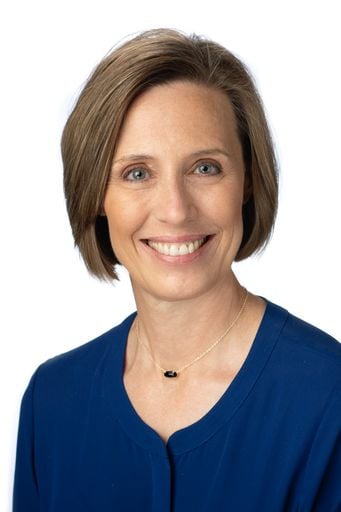
When Dr. Kay Anderson was growing up on a farm near Concord, Nebraska, she never imagined that her journey would one day take her from rural Nebraska to medical missions in Africa and back home again to care for generations of Nebraska families.
Raised in Northeast Nebraska, Kay spent her summers riding horses, doing farm work, participating in 4-H projects, and walking beans. At age 16, after earning her driver’s license, she took a job as a nurse’s aide at a hospital in nearby Wayne, where her mother worked as a nurse. The experience exposed her to every corner of healthcare—from central supply to the pharmacy—and solidified her dream of helping people through medicine.
“I always wanted to be a nurse, like my mom,” Kay recalls.
After graduating from Laurel-Concord High School in 1981, she enrolled in the accelerated nursing program at the University of Nebraska Medical Center. The program operated year-round, allowing her to earn her nursing degree in just two years. By age 20, she was a registered nurse.
It was during nursing school, while playing on a coed volleyball team with first-year medical students, that Kay had a realization that would change her life.
“Becoming a doctor had never crossed my mind, as I had never encountered a female physician. I knew these med students had graduated at the top of their classes, and so had I,” she said. “If they could do it, I figured I could too.”
After graduating in 1983, Kay spent a year working as a nurse to save money and confirm her desire to pursue medicine. Finding few nursing opportunities in Nebraska during the farm crisis of the 1980s, she accepted a position at Presbyterian Medical Center in Dallas, Texas. Working in the hospital’s float pool allowed her to gain experience in a wide variety of clinical settings while continuing to evaluate her future.
In the fall of 1984, she returned to Nebraska and enrolled at the University of Nebraska–Lincoln to complete the coursework necessary for medical school. While working part time as an RN, she earned a bachelor’s degree in social work. Her backup plan was to pursue an advanced degree in public health, providing a meaningful career path if medical school did not work out.
Not everyone shared her confidence.
Shortly before graduation, an advisor told her that she likely would not gain admission to medical school because her degree in social work was “not very academically impressive” compared to applicants with chemistry and biology degrees.
Fortunately, Kay didn’t listen. She applied to UNMC and was accepted during the first round of admissions. In the fall of 1987, she began medical school at a time when women represented only about 30 percent of medical students.
Initially, Kay envisioned a career in geriatrics, having worked extensively with older adults as a home health nurse during her undergraduate years. But during her third-year pediatric rotation, she immediately knew she had found her calling.
Following graduation, Kay matched into pediatric residency at the University of North Carolina at Chapel Hill. As a Tar Heel, she had the opportunity to experience the legendary Dean Smith era up close. During a sports medicine rotation, she cared for several student-athletes and attended a few UNC basketball games, gaining a behind-the-scenes appreciation for one of college basketball’s most iconic programs.
During this same season of life, another important chapter was unfolding.
Kay met her future husband, Todd, while attending UNL. Although the couple separated for a time while she attended medical school and he lived in Colorado, they reconnected during her fourth year of medical school after bumping into each other at a Husker football game. Their relationship blossomed once again, and the two eventually married. Today, they have two daughters, two sons-in-law, and two grandsons.
One of the most transformative experiences of Kay’s life occurred during her senior year of medical school.
Inspired by stories she had heard as a child from a missionary who visited her church in Concord, she pursued an opportunity to complete an international medical rotation in Africa. Through a scholarship program that supported medical students serving in developing countries, Kay traveled to Kenya in January 1991.
She arrived in Nairobi just days before the Gulf War began and during the height of the HIV epidemic. After a 12-hour bus ride to Friends Lugulu Mission Hospital near the western border of Kenya, she encountered an unexpected challenge: no one at the hospital knew who she was or why she had arrived. The American supervising physician was still on furlough elsewhere, and with limited phone access and no email, there was no easy way to communicate such details.
Despite the rocky start, Kay quickly immersed herself in the work and fell in love with both the people and the mission.
Six weeks into her stay, she learned that Pan Am Airlines had gone out of business and her return flight home had been canceled. Determined to continue serving, she traveled back to Nairobi, secured a new flight home, and returned to the rural hospital to complete the remainder of her planned twelve-week rotation.
The experience proved life changing. What began as a medical school rotation became the foundation for a lifelong commitment to global health and medical missions.
Over the years, she has returned to Africa multiple times, even bringing her daughters along to experience mission work firsthand. This July, she will embark on her fifth mission trip to Africa through Southwood Lutheran Church, continuing efforts to improve healthcare through education. During her visits to Tanzania, she has taught the “Helping Babies Breathe” curriculum, a neonatal resuscitation program designed for resource-limited settings. She recently secured a used portable ultrasound machine to advance prenatal care, and this summer a library of health education videos from Global Health Media will be provided to support ongoing training efforts.
Her commitment to global health has extended beyond Africa as well. Throughout the 2000s, Kay participated in approximately a dozen medical mission trips to Honduras and one to Nicaragua through Southwood Lutheran Church. There, she treated children with common illnesses while incorporating health education into every visit. Her husband and daughters frequently joined her, making service a family endeavor. One young family friend who traveled with them to Honduras at age 12 was so inspired by the experience that she returned many times and now operates The Children’s Home Project, where she continues serving children and families in Honduras.
After completing residency, Kay accepted her first pediatric position in Holdrege, Nebraska, Todd’s hometown. After a year, the family relocated to Lincoln, where she spent three years practicing at Mutual of Omaha Health Plans of Lincoln, a health maintenance organization in downtown Lincoln. During that time, she enjoyed caring for many Vietnamese refugee families who settled in Lincoln in the late 1990s. Last year, she traveled to Vietnam to better understand the places those families came from and the challenges they endured.
When that clinic closed, her next career move would become her professional home.
While taking her daughter Sydney to a pediatric appointment, Kay was recruited by Dr. Ebers of Lincoln Pediatric Group. She joined the practice and has remained there ever since, caring for thousands of Nebraska children and families for the past 28 years.
As one of only two female physicians in the group at the time, Kay recognized a need for specialized breastfeeding support. She became a breastfeeding medicine specialist and helped build Lincoln Pediatric Group’s lactation program from the ground up.
The program itself stands as a testament to the strength of independent medicine. Around 2003, physician and administrative leaders identified a gap in care, worked through the logistics and financial challenges, and created a sustainable breastfeeding medicine program that continues to serve families today. Because independent practice allowed those closest to the need to act, countless mothers and infants have benefited from the program over the past two decades.
For decades, Kay has guided new mothers through the challenges and joys of feeding and caring for their newborns, providing expertise, reassurance, and encouragement during some of life’s most important moments.
Her leadership in maternal and child health has earned recognition across the community. In 2014, she received the Hanigan Award from the Lincoln-Lancaster County Health Department for her leadership, advocacy, and clinical expertise supporting the Lincoln Community Breastfeeding Initiative.
Today, Kay continues to serve children and families in yet another important role.
Last year, she was appointed to Nebraska’s Child Death Review Team, a multidisciplinary group funded through the Nebraska Department of Health and Human Services. The team includes attorneys, law enforcement officials, social workers, pediatricians, neonatologists, maternal-fetal medicine specialists, and others who review child deaths across the state to identify trends, determine preventability, and improve future outcomes.
Kay specifically reviews medical and sudden infant death cases, helping Nebraska better understand how to prevent child deaths and improve the health and safety of its youngest residents.
From a farm girl in Northeast Nebraska to a pediatrician, breastfeeding medicine specialist, global medical missionary, and advocate for children’s health, Dr. Kay Anderson’s career has been defined by service, leadership, and compassion.
Her story is a powerful reminder of the impact independent physicians can have on the communities they serve—not only in Nebraska, but around the world.
OneHealth Nebraska is proud to recognize Dr. Kay Anderson for her lifelong commitment to caring for children, supporting families, advancing public health, and strengthening independent medicine. Physicians like Dr. Anderson embody the innovation, dedication, and community-centered care that independent practice makes possible.
Order Pure Molecule relief Meds Canada ✅
Europas Premium-Papageien aus Hausaufzucht 🦜
Ragdoll-, Siam- & Ragamese-Kätzchen europaweit🐱